- Becoming AI-Native
- Posts
- ⏱️ You’re not behind on AI. And that’s the problem.
⏱️ You’re not behind on AI. And that’s the problem.
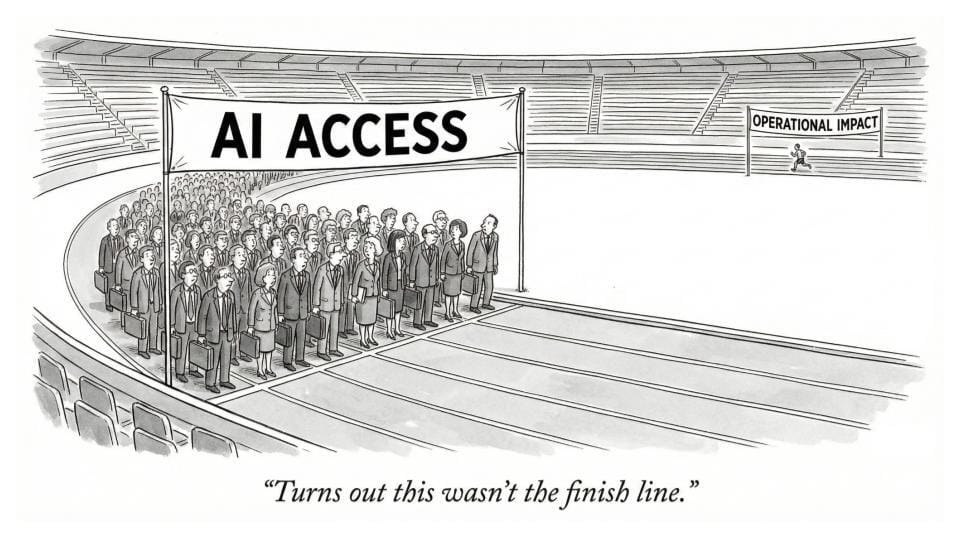
Turns out this wasn’t the finish line.

Dino Gane-Palmer
January 20, 2026 • Estimated Reading Time: 2 minutes
Hi, and happy Tuesday.
A few months ago, I sat in a room with a leadership team that was feeling great about their AI progress.
“Copilot adoption is at 72%,” someone said.
“Usage is up quarter over quarter,” said another.
And then someone asked a question that killed the mood:
“So… what’s actually faster or cheaper now?”
There was silence.
No one could name a single core workflow that had fundamentally changed.
I’ve been finding that moment repeating itself again and again over the last few months - across industries, across roles, across very smart teams.
Which brings me to the uncomfortable truth:
AI access is everywhere, but AI maturity is not.
Despite what the headlines suggest, your organization is probably not behind on AI.
Smaller companies, the tech sector and businesses directly impacted by Generative AI are pushing what is possible with Generative AI.
But these are generally not the types of companies we work with.
Over the last four months, we’ve worked closely with ~30 enterprise organizations - teaching AI masterclasses, running readiness audits, and building custom systems inside real workflows.
When we mapped where these more product based / manufacturing companies actually sit, a strange pattern showed up.
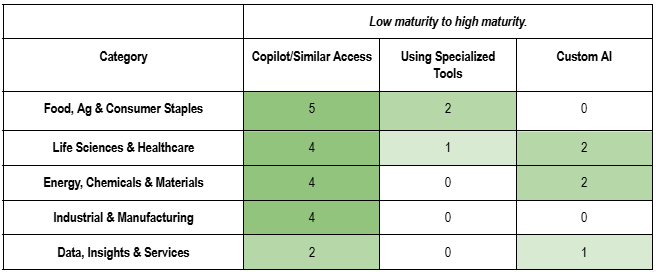
Various types of organizations we have worked with over the last 4 months, mapped by maturity.
Admittedly, 27 companies is a small dataset. But, based on knowing these organizations fairly well:
Baseline tools are everywhere (Copilot, ChatGPT, etc.)
Specialized generative AI tools have either not been considered, not been found or not stuck when they have been used
A small fraction of organizations have developed more sticky custom solutions
The custom solutions span use cases such as:
Accelerating regulatory workflows
Supporting operational decisions
Automating high-friction internal processes
What does all this mean?
Copilot adoption is no longer a leading indicator.
Right now, most organizations are tracking AI the same way they track software rollouts, such as licenses provisioned or active users.
Those metrics feel good. They give leaders something to report.
But here’s the issue:
AI access is now a baseline condition. Like email, search and Slack - everyone now has it.
But it is also the starting line, and many organizations are still stuck there.
AI needs to move from being something people use and start being something organizations rely on.
The simple test to try today:
“Which recurring decision or workflow now completes faster without someone prompting AI?”
If you can’t name one, maturity is still effectively zero - no matter how many licenses you’ve rolled out.
Reply and tell me if you’re seeing this tension - or where you disagree.
I’m genuinely curious if any of this resonates, or if my sample is off-base.
Until next time,

Dino