- Becoming AI-Native
- Posts
- Underdog → AI Monopoly
Underdog → AI Monopoly
What we can learn from Anthropic’s focus

Dino Gane-Palmer
May 18, 2026 • Estimated Reading Time: 3 minutes
Hi, and happy Monday.
The best strategy for driving adoption within your team or organization?
It’s the exact same one Anthropic has used to outcompete its rivals.
Anthropic spun out of OpenAI in 2021, when a noble band of safety researchers walked out to build AI “more responsibly”.
Following the viral sensation of OpenAI’s ChatGPT, though, Anthropic found themselves underfunded and late to the game. Anthropic’s product - Claude - was, for years, slightly worse than ChatGPT at most things.
The polite consensus in tech circles was that Anthropic would be the “also-ran” - comparable to Lyft, Microsoft Bing or AMD.
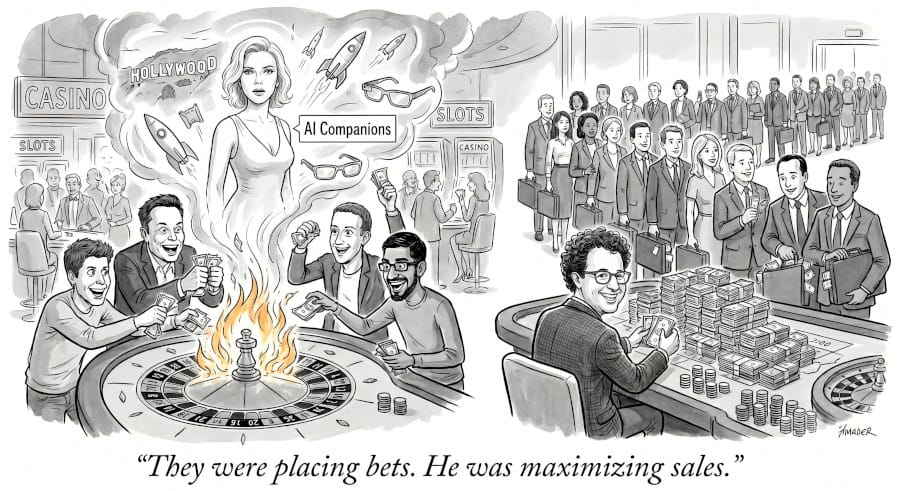
Meanwhile, competitors, flushed with cash, bet big:
OpenAI launched Sora, to rival Hollywood, has been building an ads business and has dived into making a secret AI device.
Google bolted Gemini onto every surface it owns, which is roughly half the consumer internet.
Grok generated images of whatever you wanted, ethics optional, while xAI built out a multi-billion-dollar data center in Memphis in record time.
Meta open-sourced models and started designing AI glasses.
The AI category map looked like a Vegas casino floor - every lab betting on every table, hedging across every plausible AI future at once.
Anthropic, cash-strapped by comparison, did not have the budget to hedge. So they picked one table: The bet was enterprise and code.
This was not the most glamorous corner of the AI market: there are no video reels of cartoon ducks rendered in 8K, no celebrity voice clones or any flashy consumer travel booking demos.
Anthropic remained focused on improving Claude to empower software developers and other knowledge workers. The conventional wisdom was that this was a thin slice - not the bigger market.
The result of this focus? To this day, Claude is not able to generate images. But, while the rest of the industry has been selling “vibes,” there is now a growing realization that Anthropic has been quietly selling gold.
For the last three years, Anthropic has been growing at roughly 10x annually - a pace most observers assumed would have to stop in 2026. Why? Because numbers this large usually start slowing down, and growth had already started to slow down for OpenAI.
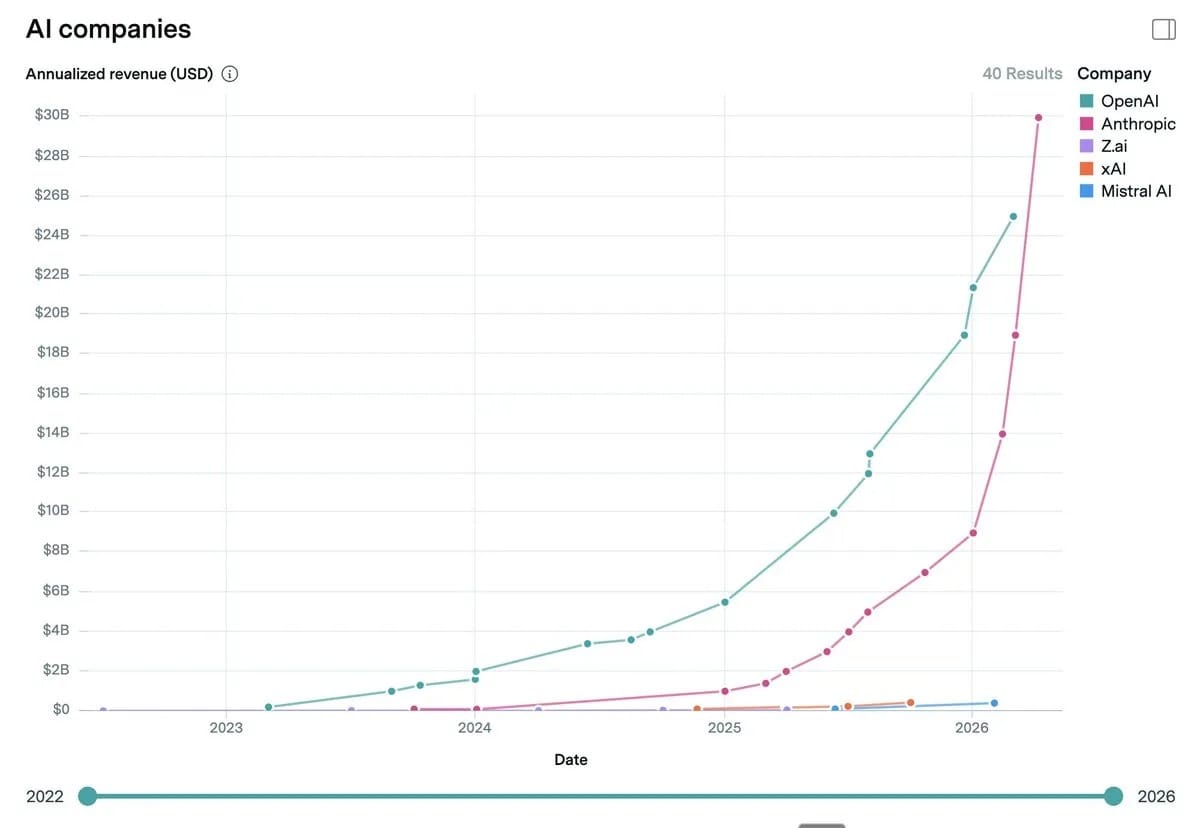
Revenues of each of the AI labs
But, the slowdown did not materialize.
Anthropic entered the year at roughly $10B in ARR, and ended Q1 at $30B (i.e. tripling in a single quarter), and was at $44B by the end of April.
The original "10x for the full year" forecast - to end 2026 at ~$100B in ARR - is now being described inside the industry as a foregone conclusion.
The active debate has moved to whether Anthropic does $1 trillion in ARR by 2027.
For scale: Walmart and Amazon, the two largest revenue businesses on Earth, each do roughly $700B per year - and that revenue is not recurring. They have to re-earn it each month, quarter, and year.
ARR - Annual Recurring Revenue - is the version of revenue that investors will mortgage their grandchildren to buy a multiple of. A trillion in ARR isn't just "biggest software company ever." It is, plausibly, the most valuable company that has ever existed in any category, anywhere.
Anthropic would be more valuable than Apple, Microsoft, Google and Meta - combined.
Only two things stand between Anthropic and this historic trajectory:
(1) Whether they can bring enough compute online fast enough to serve demand. The bottleneck? Roughly half of the new US gigawatts scheduled for this year are tied up in local protests.
(2) How quickly rivals will catch up with Anthropic, and lure customers away.
There is a lesson buried in all of this for anyone running an AI program inside a normal company, but it's the opposite of what most people are doing.
When driving AI adoption, the reflexive move is to spread bets across every plausible use case: a chatbot here, a summarizer there, an image pipeline for marketing, a voice agent for support, a forecasting model for operations.
Candidly, we’ve often gotten caught up with this “laundry list” approach ourselves. The logic feels prudent: diversify, learn and then see what sticks.
But this is precisely the playbook that has left OpenAI, Google, Meta, and xAI scrambling to refocus on what Anthropic spotted three years ago.
Diversification across speculative bets is the tax you pay for not knowing which bet matters. When the cost of being wrong was small, that tax was cheap. But when the cost of “spreading yourself too thin” means being lapped 10x a year by someone who chose, the tax becomes fatal.
Where we’ve partnered with clients who’ve wanted to focus on one or two key workflows - we’re seeing them pull ahead too. We’ve just been able to obsessively iterate on the smallest details to make these use cases work.
Tomorrow, we're running a webinar to spotlight who we are focusing attention inside PreScouter. You'll see how we're using Claude Cowork for the analyst-heavy knowledge work, and how we're constructing what we've come to call an "AI employee": not a chatbot, not a copilot, but a configured agent that owns a defined set of work end-to-end.
If you've been hedging across ten AI experiments waiting for clarity, what Anthropic shows us is that clarity is not coming. You have to choose.
Join us tomorrow, and we'll show you what we picked, and why.
Best,

Dino