- Becoming AI-Native
- Posts
- Goodbye, PowerPoint
Goodbye, PowerPoint
Plus two more shifts from the last two weeks.

Dino Gane-Palmer
April 28, 2026 • Estimated Reading Time: 3 minutes
Hi, and happy Tuesday.
Today, we have noteworthy three stories from the last two weeks, each with a link if you want to go deeper.
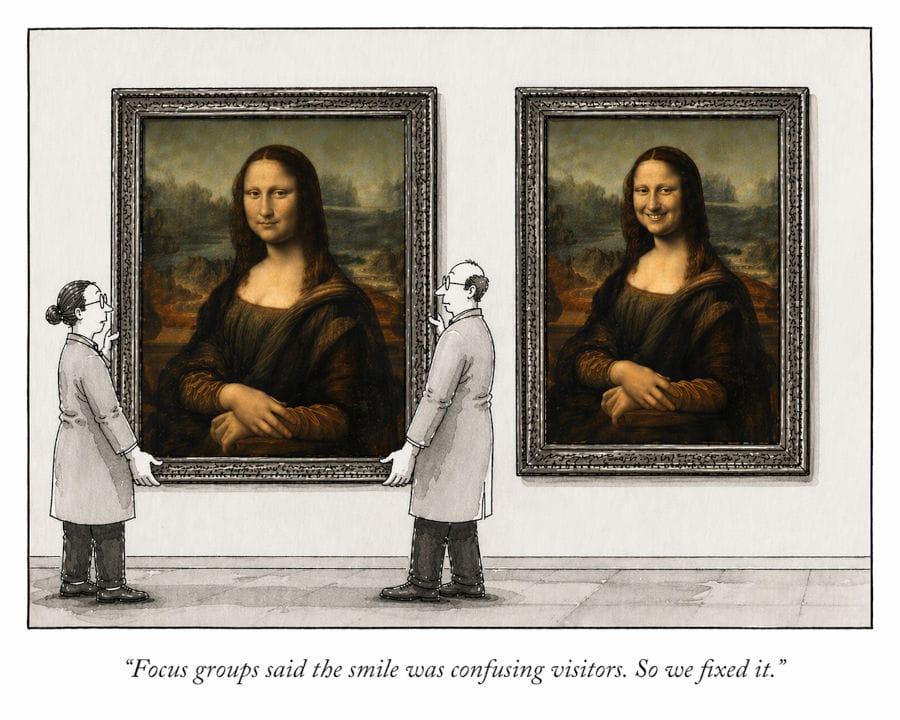
Image generation may end PowerPoint. And the Mona Lisa smile.
AIs are crossing the "competent employee" threshold.
NVidia CEO Jensen Huang’s viral clip is the case for a multi-model AI strategy.
Let's get into it.
—---
1. Image generation was "solved." Now its ending Powerpoint.
Back in October, when Google released Gemini’s "nano-banana" image model, the consensus - including from OpenAI CEO Sam Altman himself - was that image generation was basically “solved.
The models could render hands (mostly), generate legible text (finally), and mimic any artistic style on demand.
The remaining ways in which image generation could improve in future seemed likely to be more like “polish.”
Nevertheless, OpenAI ploughed more compute into building a new generation of image models.
The fruits of that labor was released two weeks ago, and the results have been surprising.
The new model GPT Image 2 model doesn't just generate an image from your prompt - it interprets your intent.
You can, for example, show it the front of a house, and it'll produce a plausible floor plan - informed by the architectural style, the era, the neighborhood. Not correct, exactly. But coherent and convincing.
We’re going to see it used to solve all kinds of previously “unsolvable problems” - such as the Mona Lisa smile. Also expect counterfeit and fake images to skyrocket; let your customer complaints teams know.
On a practical level, GPT Image 2 is incredibly good for creating slides. You can give it your text, images and a specific template, brand guide or style - and it will create a formatted slide for you (as an image). I expect OpenAI or Microsoft will introduce a user interface better suited for this use case than leaving us to rely on chat.
2. AIs are approach “competent employee” level
OpenAI also released GPT 5.5. In most benchmarks - it's now the best model for most tasks. I’ve found it writes less fluff and its answers seem more expert.
Nevertheless, I’m still finding Claude Opus 4.7 to be the best model for creating reports, code and artifacts. But GPT 5.5 is incredible at reviewing Opus’s output and improving it. Orchestrating the two models in this way - with Opus creating first drafts and GPT reviewing the work - I’m seeing them produce outputs at a level of a competent employee.
The gap between the models we had 12 months ago and the ones we have today is enormous, but most people have stopped paying attention. Ethan Mollick has built a side-by-side that lets you see the progression from o3 (released in April 2025) to what we have now, with GPT 5.5, against the same prompt - a 3D simulation of a harbor town.
3. Which is exactly why a multi-model strategy matters now.
NVIDIA CEO Jensen Huang went viral last week pushing back on restrictions to selling chips into China. His argument: if American companies don't own every layer of the AI stack, countries hostile to the US will build their own equivalents - and they may become the global standard.
When pressed on whether it is even worthwhile for US companies to enter the China market - pointing to Tesla and Apple's struggles to gain market share against Chinese competitors - Huang's response was sharper than anyone expected.
→ Watch Jensen Huang’s “I wasn’t born a loser” moment (2 min video)
The takeaway for enterprise leaders isn't geopolitical - it's strategic.
Chinese frontier labs arguably produce the best open source models in the world, and they are often only 3 to 6 months behind the closed US models. It is increasingly possible to host these models yourself.
As your organization increases AI model use - driven by expensive agentic workflows - hosting your own models will become a necessity to contain costs. Betting the whole organization on a single vendor, chip platform, or frontier model is starting to look like the riskier move, not the safer one.
The best hardware for hosting your own models? Apple Mac Studios and NVidia DGX - i.e. machines from the two big tech companies not spending billions of dollars on building data centers (though NVidia makes chips for said data centers).
—--
And if you enjoy a little bit of AI drama, the OpenAI vs. Musk trial just kicked off. Musk is trying to invalidate OpenAI's for-profit structure and claw back funds, with damages reportedly in the billions. The trial runs through mid-May, so expect headlines everywhere.
See you next week.

Dino